They need to look good on a shelf. They need to explain what is inside. They need to help customers choose between coffees. They also need to signal what the roaster cares about.
That might sound straightforward, but it’s not.
A coffee bag label has limited space, and every detail competes for attention. Should the roaster highlight the origin region? The farm? The process? The altitude? The variety? The tasting notes? The roast level? Certifications? How big should their logo be? What color schemes are best?
To better understand what roasters think about these questions, we randomly selected 120 roasters with the objective of reviewing their retail bag labels for their single origin coffees, as shown in their online shops. We looked at what each roaster depicted as the actual label on their standard bags of coffee, not what information was included in the narratives on the shop pages.
Only 98 of the 120 roasters in our sample had those visual depictions of their labels; the remaining 22 instead had a mix of other pictures, graphics, or other placeholders.
For the group of 98 roasters with usable images for us to analyze, the goal was not to judge whether one label style is “right.” Instead, this analysis looks at what labeling information is common, what is rare, and what those choices reveal about how specialty coffee is presented to consumers in an e-commerce setting.
This analysis does not tell us what coffee information a roaster possess, it only tells us what they’ve chosen to put on their labels.
The short summary: most roasters clearly tell customers where a coffee comes from and what it tastes like. Fewer roasters include deeper production details, such as farm, farmer, altitude, variety, or certification seals.
That gap matters. It says a lot about how roasters balance accessibility, traceability, and retail clarity.
The Most Common Coffee Bag Label Details
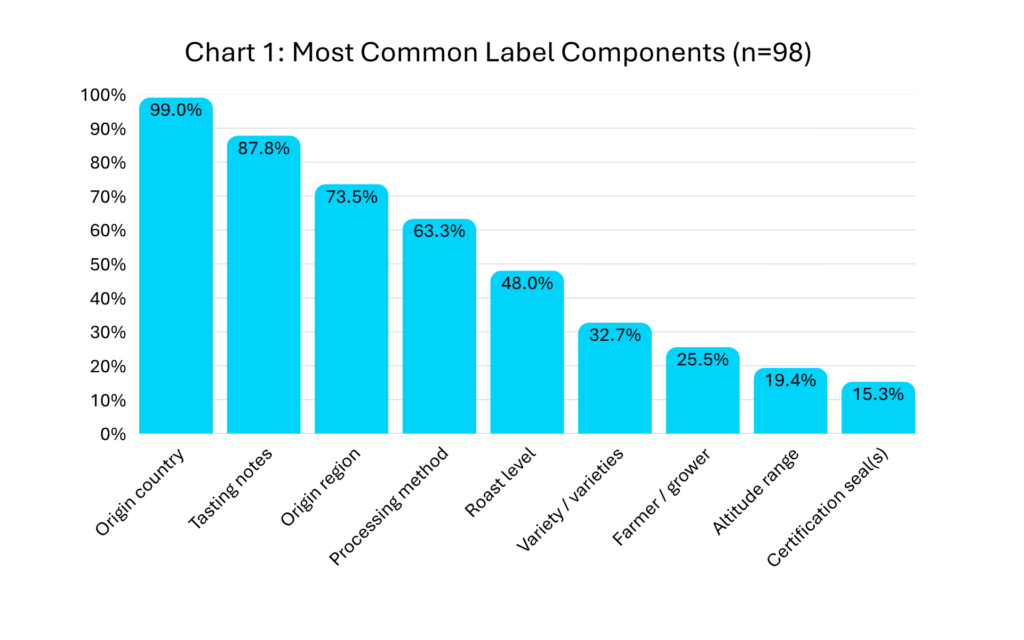
Among the 98 roasters with usable label data, two pieces of information appeared more than anything else: origin country and tasting notes.
This pattern makes sense.
The origin country gives consumers an immediate anchor. Ethiopia, Colombia, Guatemala, Kenya, Brazil, and Peru all carry meaning for coffee drinkers, even if that meaning is broad. Country is the fastest way to place a coffee in the world.
(Note that 99% of the roasters in our sample listed origin on their labels – that is not a typo. One roaster included that information in the narratives on their shop pages, but the depictions of their bag labels appeared to omit that key piece of information.)
Tasting notes do something different. They help customers imagine the cup. A label that says “Colombia” gives context. A label that says “chocolate, citrus, red fruit” gives direction.
Together, country and tasting notes form the basic language of specialty coffee retail.
In this dataset, 85 of the 98 usable labels included both origin country and tasting notes. That is 86.7% of the sample. In other words, the dominant label formula is simple: tell people where the coffee is from, then tell them what it tastes like.
That is probably the right starting point.
For consumers, those two pieces of information are easy to understand. For roasters, they communicate value without overwhelming the bag.
Region Is Common, But Not Universal
The next most common label component was origin region, which appeared on 72 labels, or 73.5% of the usable sample.
This is an important step beyond country-level labeling. Country alone can be very broad. Colombia, for example, contains many coffee-growing regions with different elevations, climates, varieties, and cup profiles.
Region gives the coffee a more specific identity.
For consumers, region may not always be familiar. A casual buyer may know Colombia but not Huila, Nariño, or Tolima. Still, region can signal that a roaster is offering something more specific than a generic origin.
For roasters, region is a useful middle ground. It adds traceability without requiring too much explanation.
The combination of country, region, and tasting notes appeared on 65 labels, or 66.3% of the usable sample. That is a strong sign that many roasters view region as part of the basic specialty coffee label package.
This is where specialty coffee starts to separate itself from commodity-style packaging. The coffee is not just “from Colombia.” It is from a place inside Colombia, and that place can be identified.
Processing Method Is a Major Labeling Signal
Processing method appeared on 62 labels, or 63.3% of the usable sample.
That is a high share, but not as high as origin or tasting notes. This is one of the more interesting findings.
Processing method has become one of the most useful ways to understand how a coffee may taste. For highly engaged coffee drinkers, process matters a lot. For casual consumers, it’s probably one of the least understood specialty coffee variables. Understanding primary processing methods like washed or natural is one thing, but relying on a coffee consumer to know about co-fermentation or carbonic maceration is something else.
Some roasters may have decided that the marginal clarity provided by process did not justify the precious label space it occupied. That may explain why process appears often, but not universally.
Roast Level Appears on Less Than Half of Labels
Roast level appeared on 47 labels, or 48.0% of the usable sample.
That number surprised us.
Roast level is one of the most consumer-friendly pieces of coffee information. Many shoppers naturally think in terms of light, medium, and dark roast. Even people who know little about origin, process, or variety usually understand roast level as a buying cue.
So why do fewer than half of roasters include it?
One likely reason is that many specialty roasters operate within a relatively narrow roast range. They may not want to label a coffee “light” or “medium” because those terms can mean different things to different people.
Another reason may be brand positioning. Some roasters want consumers to focus on origin and flavor rather than roast category. For those roasters, roast level may feel too blunt or distracting.
Still, from a consumer perspective, roast level can reduce friction. A buyer who wants something balanced may hesitate if the label gives origin, process, and tasting notes but no roast guidance. Roast level can be a bridge to such a buyer.
For roasters, this is a strategic choice. Leaving roast level off the bag may appeal to experienced buyers. Including it may help newer customers choose more comfortably.
The data shows that roasters are split almost evenly on this question.
Farm, Farmer, Altitude, and Variety Are Much Less Common
In a sector that emphasizes traceability as a differentiator, the deepest traceability details in fact appeared far less often.
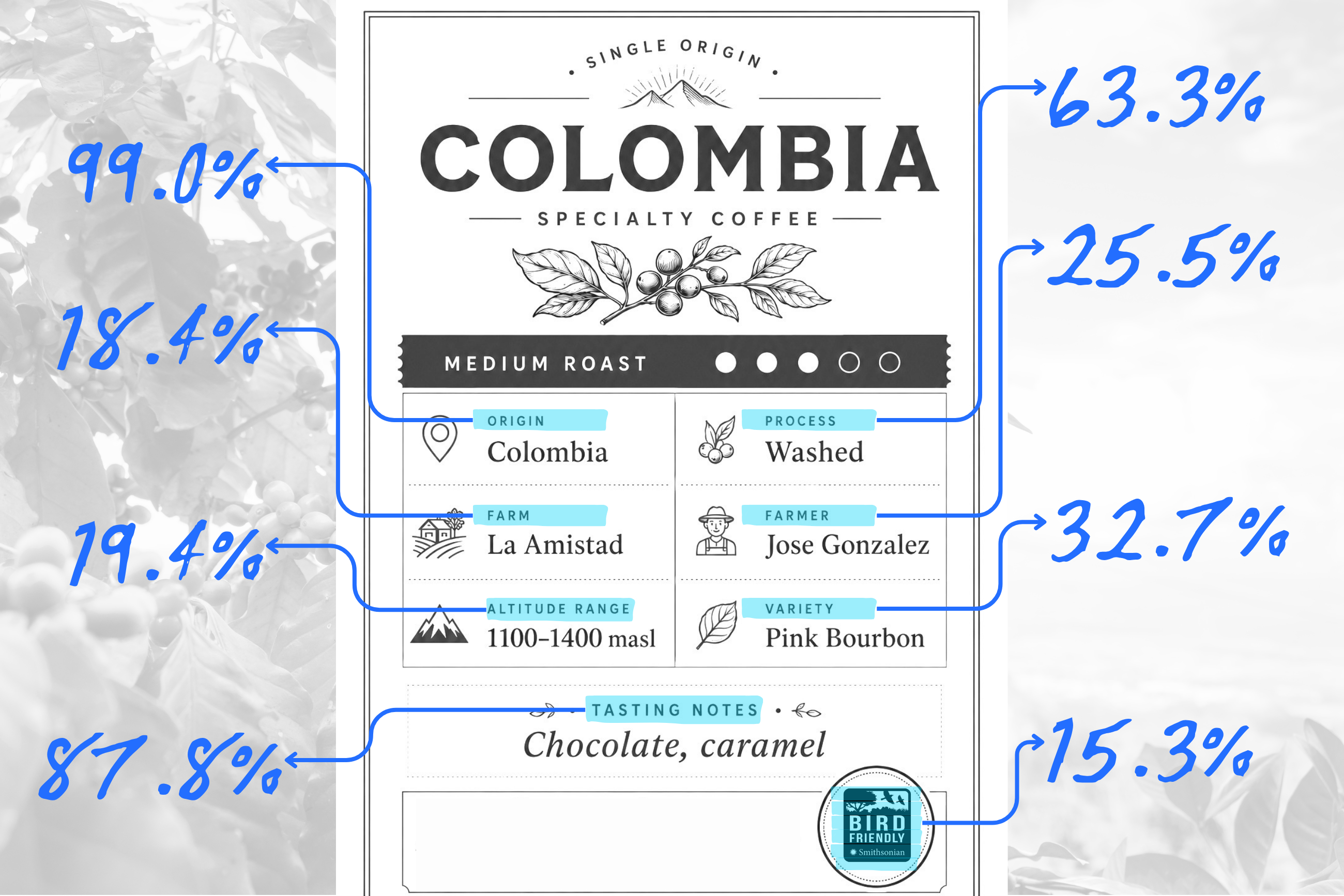
Only 18.4% of labels included the farm. Only 25.5% included the farmer or grower. Altitude appeared on 19.4% of labels. Variety appeared on 32.7%.
These are all meaningful details. They matter in specialty coffee, especially as roasters try to differentiate their coffees with farm-level narratives and connections. But they are not mainstream label components, at least in this dataset.
That creates an interesting tension.
Specialty coffee often talks about transparency, traceability, and producer relationships. Yet most bags do not include farm or farmer information directly on the label.
That does not mean roasters lack that information. Many may include it on product pages, QR codes, brew cards, or longer descriptions online. But the bag itself usually remains more selective.
This likely reflects a practical reality. Bag labels have limited room. Roasters have to choose what helps the buyer most at the point of purchase.
Farm and farmer details may carry strong ethical and storytelling value. But they may not help every customer decide between two bags.
Variety and altitude face a similar challenge. They matter to coffee professionals and enthusiasts. But many consumers do not know what Bourbon, Typica, SL28, Caturra, or Gesha imply. They may also struggle to interpret altitude without context.
For roasters, these details can strengthen credibility. But they work best when the rest of the label gives customers a clear path into the coffee.
Certification Seals Are Rare on Specialty Coffee Labels
Certification seals appeared on only 15 labels, or 15.3% of the usable sample.
That is one of the clearest findings in the dataset.
Certifications may include things like Organic, Fair Trade, Rainforest Alliance, Smithsonian Bird Friendly, or other third-party seals. These certifications can matter a lot to certain consumers. They can also support claims around farming practices, sourcing standards, and environmental impact.
Yet most specialty roasters in this sample did not display certification seals on their typical retail bag labels.
There are several possible explanations.
The most obvious is that a lot of coffees are not certified. Some roasters may source through relationship-based models instead of certification-based models. Some may mention certifications on product pages but not on the bag. Others may avoid visual clutter and keep the front label focused on origin and flavor.
For consumers, this is worth noticing. The lack of a certification seal does not automatically mean a coffee is unsustainable or poorly sourced. But it does mean the buyer may need to look elsewhere for sourcing information.
For roasters, the takeaway is more strategic. If a coffee does carry a meaningful certification, the bag may be an underused place to communicate it.
This is especially true for certifications that consumers can understand quickly. Organic is familiar. Bird Friendly is distinctive. Fair Trade is recognizable. Those signals can help a bag stand out, especially when paired with a clear explanation online.
Most Labels Include About Five Components
The typical coffee label in this dataset included a moderate amount of information.
Across the 98 usable labels, the average number of included components was 4.8, and the median was 5.
This is useful because it shows that most roasters are not at either extreme.
They are not putting only one or two details on the bag. But they are also not listing every possible production variable.
This suggests a rough industry norm. A typical specialty coffee bag gives enough information to feel specific, but not so much that the label becomes a technical sheet.
For many roasters, that may be the right balance.
A five-component label might include country, region, process, tasting notes, and roast level. Or it might include country, region, process, tasting notes, and variety.
Both versions feel complete without becoming dense.
Common Label Combinations
Looking at individual components is helpful. But combinations reveal more about how roasters package information.
Here are several common bundles from the dataset:
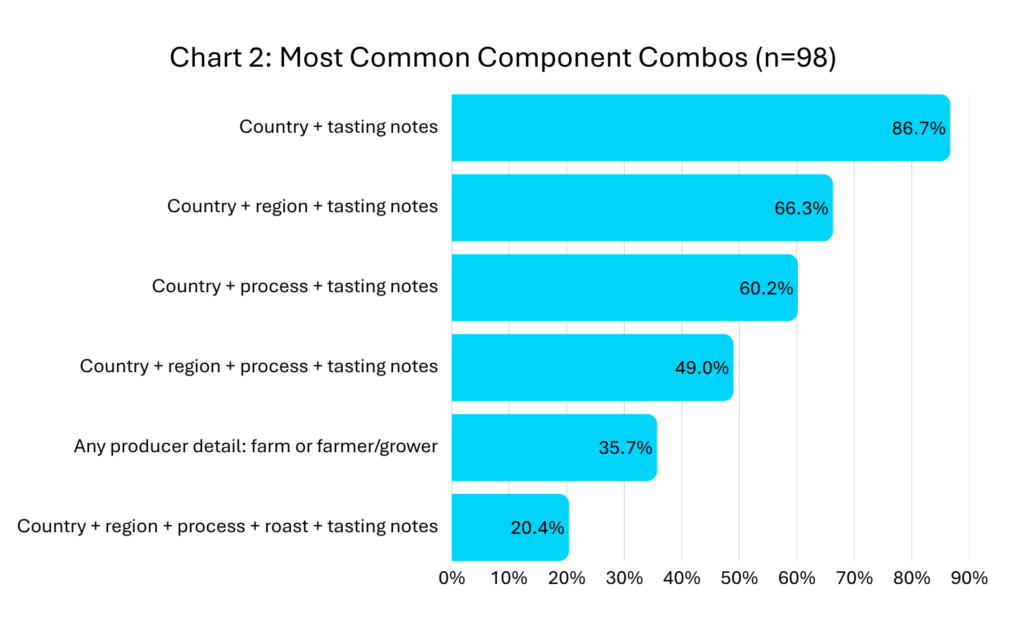
The clearest pattern is that labels tend to build around a core of origin plus flavor.
From there, roasters add context. Region is the most common addition. Process is the next major layer. Roast level, variety, farmer, farm, altitude, and certifications appear more selectively.
That creates a kind of label hierarchy:
Basic: country + tasting notes
Stronger: country + region + tasting notes
Specialty standard: country + region + process + tasting notes
More technical: add variety, altitude, farm, or farmer
More values-driven: add certifications or sourcing claims
This hierarchy is useful for both roasters and consumers.
For consumers, it shows which details are most likely to help with quick buying decisions. For roasters, it shows how to decide what belongs on the bag versus what belongs on the product page.
What Consumers Can Learn From Coffee Labels
For consumers, the biggest lesson is that coffee labels are selective.
A bag rarely tells the whole story. It tells the story the roaster believes will help you choose.
If you want a simple way to read a label, start with three questions.
First, where is the coffee from? Country and region help you understand the coffee’s broad identity.
Second, what does the roaster say it tastes like? Tasting notes are not exact flavor guarantees. But they are useful signals. A coffee labeled with chocolate, caramel, and almond will probably feel different from one labeled with raspberry, florals, and citrus.
Third, how was it processed? This detail can tell you a lot once you learn the basics. Washed coffees often lean clean and clear. Natural coffees often lean fruitier. Experimental processes can create more unusual flavors.
After that, look for deeper details. Farm, farmer, variety, altitude, and certifications can add more context. But their absence does not automatically mean the coffee lacks quality.
It may only mean the roaster chose to keep the label simpler.
What Roasters Can Learn From This
For roasters, this data points to a clear opportunity.
Most roasters already include the expected basics. Nearly everyone includes country. Most include tasting notes. Many include region and process.
That means those components are no longer major differentiators by themselves.
The opportunity is in how clearly the label helps a customer choose.
A strong label does not need to include every detail, it just needs to include the right details in the right order.
For most roasters, the core label should probably include:
- Origin country
- Region, when available
- Tasting notes
- Processing method
- Roast level or another consumer-friendly taste cue
From there, roasters can decide whether deeper traceability details belong on the physical bag.
If a coffee has a strong producer story, include the farm or farmer. If variety matters to the coffee’s identity, include it. If a certification is meaningful, show it clearly. If altitude adds little for the buyer, it may be better online than on the label.
The key is not to add more information for its own sake.
The key is to reduce uncertainty.
A good coffee label helps a shopper think, “I understand this coffee, and I know why I might like it.”
The Bigger Pattern: Specialty Coffee Labels Are Still Built Around Taste
This analysis shows that specialty coffee labeling remains heavily centered on taste and origin.
That is not a bad thing. It reflects how people buy coffee. Most customers want to know where the coffee is from and whether they will enjoy drinking it.
But the data also shows that many values-based and traceability-based details stay in the background.
Farm, farmer, altitude, variety, and certifications appear much less often than country, tasting notes, region, and process. That suggests roasters still see the retail bag as a decision tool first and a transparency tool second.
There’s also a middle path to consider.
Roasters can keep labels clean while still making sourcing information easier to find. A bag does not need to become a research report. But it can point customers toward one.
That could mean a QR code, a short sourcing note, a simple certification callout, or a product page with more context.
Consumers increasingly care about where products come from. But they also need information in plain language.
The best labels will bridge that gap.
They will make coffee easier to buy, easier to understand, and easier to trust.
Summary
The typical specialty coffee bag label is not overloaded. It is fairly focused.
Most roasters include about five components. The most common are origin country, tasting notes, origin region, and processing method. Roast level appears on about half of labels. Deeper traceability details appear much less often.
Roasters want to communicate specificity, but they also know that too much information can overwhelm the buyer.
For consumers, the label is a starting point. It can guide you toward coffees you may enjoy, but it rarely tells the full sourcing story.
For roasters, the label is a strategic tool. The best labels do not simply list data. They help customers make a confident choice.
That may be the real job of a coffee bag label: not to say everything, but to say enough.