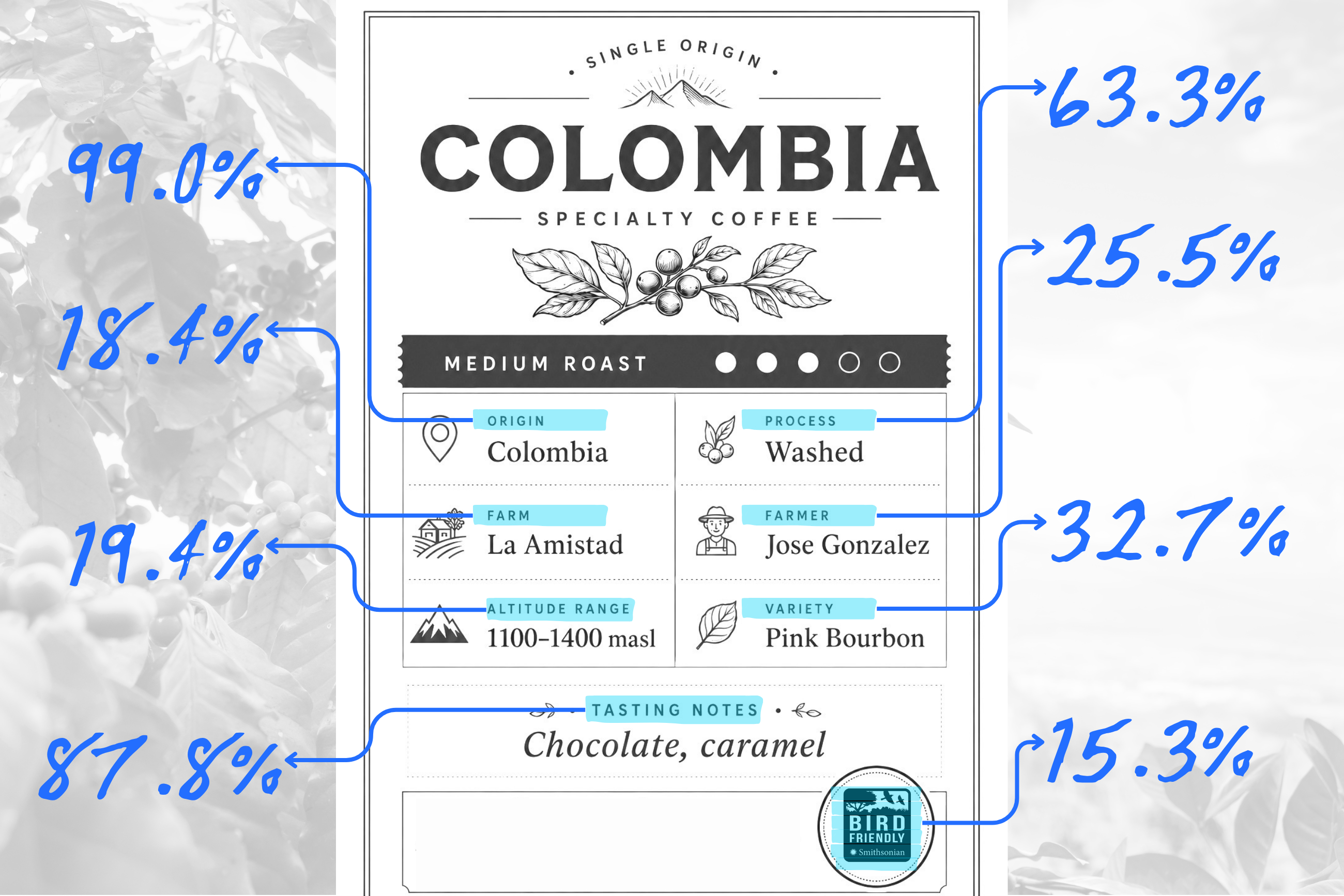
If you’ve ever bought single origin specialty coffee, you have probably seen a label that includes the altitude at which the coffee was grown. It’s usually expressed in a range of meters above sea level (MASL). For a lot of mainstay crops, altitude isn’t a critical variable – so why is coffee different? Why do roasters include it on their labels? Two major considerations:
1) altitude partially determines the taste of the coffee, and
2) altitude aids in traceability
In fact, coffee beans grown at higher elevations develop distinct characteristics that set them apart from their lower-altitude counterparts. While beans from lower regions tend to have earthier flavors, high altitude coffee beans showcase complex profiles with vibrant floral notes, pronounced fruity flavors, and a clean, crisp finish. Additionally, these elevated growing conditions create denser beans with higher concentrations of sugars and organic acids, contributing to their sought-after sweetness and balanced acidity.
What qualifies as high altitude coffee
The coffee world doesn’t have one universal standard for what constitutes “high altitude.” Generally, coffee grown above 1,200 MASL qualifies as high altitude. However, this threshold varies significantly depending on who you ask. In general:
- Low altitude: up to 750 MASL – typically milder, softer flavors
- Medium altitude: 750 – 1,200 MASL – sweeter with little acidity
- High altitude: 1,200 MASL and higher – complex flavors, pronounced acidity
High elevation coffees develop harder, denser beans because cooler temperatures slow their growth, allowing more time for complex flavors to develop. You can sometimes identify these beans visually – they typically have a fine, sometimes zig-zagged fissure line, compared to the wider, straighter line in lower-grown beans.
Regional variations in altitude classification
Coffee-growing regions around the world have developed their own classification systems based on altitude, with terms and altitudes differing depending on the source.
In Guatemala, for instance, the highest quality grade “Strictly Hard Bean” (SHB) is reserved exclusively for coffees grown 1,200 MASL.
El Salvador uses “Strictly High Grown” (SHG) as the term for coffees also grown at the 1,200 MASL threshold.
But what’s considered “high” also varies dramatically by region. Coffee grown at 900 MASL in El Salvador for example is still considered “high” (not to be confused with “strictly high grown”). In Central America, coffee grown above approximately 900 MASL is already classified as “high,” whereas in Ethiopia, quality coffee grows at elevations as high as 2,200 MASL.
Furthermore, the location relative to the equator matters tremendously. Hawaiian Kona coffee grows at just 700 MASL, but Kona is an exceptional bean despite what would be considered relatively low elevation elsewhere. This is because Hawaii’s northern latitude means higher elevations would be too cold for coffee trees to survive.
Altitude ranges and traceability
The designation of altitude on coffee packaging often appears as a range rather than a single number – for example, 1,700-2,000 MASL – representing either the varying elevations across a single farm or the different elevations of multiple farms in the same general area that are still considered a single origin. These specific altitude details have become increasingly important for coffee traceability, helping consumers understand precisely where their coffee comes from and why it tastes the way it does.
An important caveat here. Sometimes, the altitude range for a coffee is extremely wide, even up to 900 MASL (i.e. 1,200 MASL – 2,100 MASL).
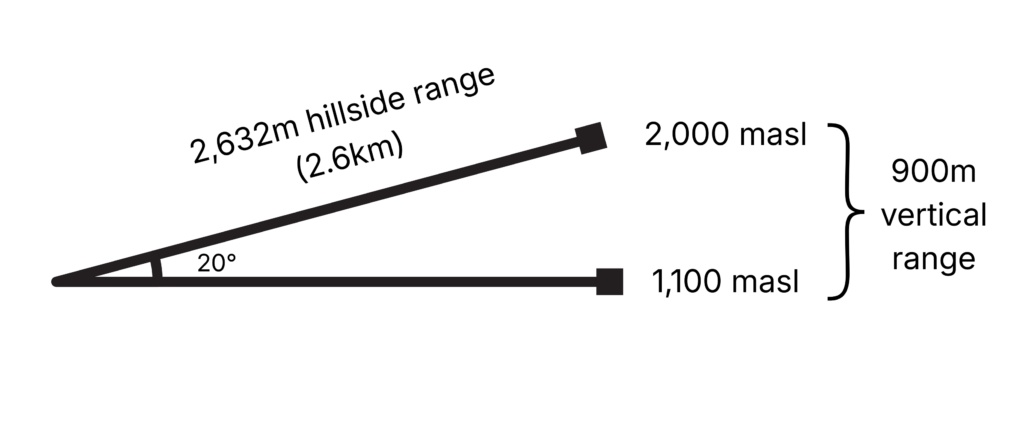
Let’s assume that refers to one farm.
In the example above, if the vertical range is 900 MASL, and we assume a 20 degree incline of the hillside, that means the actual distance up the hillside is 2.6km. Picture walking up a hillside, on one farm, for 2.6km. That’s a lot of distance and space to cover, and it is not a precise data point when it comes to traceability.
If coffee is from a co-op and many smallholders, then a wide altitude range can make sense because of the larger area the coffee is being harvested from. However, if the coffee is a micro-lot or otherwise concentrated around a tight land area, then listing a narrow band of altitude on the label should be possible.
After all, what’s the point of listing altitude as a demonstration of the coffee’s traceability if the range provided is too large to actually isolate where the coffee was grown?
Climate change threats to high altitude regions
The altitudes at which specialty coffee is grown are not necessarily fixed – they are changing and evolving as coffee-growing regions are particularly impacted by climate change. Some origins and localities can actually move coffee cultivation to higher elevations to avoid warming temperatures. One figure is that coffee cultivation may have to move higher by roughly 150 meters for every 1°C incremental increase in temperature.
Unfortunately, this creates a critical situation where farmers will eventually “run out of room” at the highest elevations where coffee can grow.
A 2022 study conducted by Zurich University of Applied Sciences in Switzerland predicts that climate change will reduce lands suitable for growing coffee globally by more than 50% by 2050. For Arabica coffee, which thrives in temperatures between 18-22°C, even minor temperature increases can disrupt the delicate conditions that create premium beans.
Besides temperature changes, altered precipitation patterns and increased pest pressure present serious threats. The coffee borer beetle, for instance, can have a devastating impact on coffee crops if left unchecked.
Summary
High altitude coffee certainly stands apart, developing distinctive characteristics through slower maturation, creating denser beans with concentrated sugars and organic acids that result in vibrant, nuanced cups.
Altitude also matters for traceability – providing a critical verifiable geolocation data point, as long as the ranges provided by the importer or roaster are not excessively wide.
Though elevated growing regions produce exceptional coffee, they face significant challenges. Climate change threatens traditional growing areas, while economic pressures impact small-scale farmers who maintain these precious mountain plots. However, farmers are adapting where they can and other innovations, such as the early detection of the coffee borer beetle, show some promise that resilience measures against climate change are not futile efforts.
Ultimately, high altitude coffee represents more than just superior taste and an opportunity for better traceability – it embodies the intricate relationship between elevation, environment, and expertise. It’s a bellwether for how the coffee market overall may respond to more climate- and economic-related challenges down the road.